Reform Radio have put together a selection of take over shows to celebrate the launch of the brand new website. Expect a wide variety of artists across the globe, from Mancunian Mr Scruff to Ok Sure based in Australia.
The special take over series kicked off on the 9th of September, with shows from Alga-rhythm’s, Mr Scruff, Yacre and DJ Raph hitting the airwaves so far. If you didn’t get a chance to listen to these shows, you can listen back at Reform’s Mixcloud.
To wrap up the celebration, we have two more shows coming up from OK Sure and QQ Circe. Ok Sure will be playing electro, techno and house on the 22nd September from 10 to 11 PM and QQ Circe’s show will be airing on the 27th September from 8 to 9 PM.
The full ‘giRLs’ compilation has been released by our sister label, Rhythm Lab Records.
The compilation features collaborations made possible by the Rhythm Lab International Women’s Day Fund supported by Arts Council England.
The 3 tracks were born out of Rhythm Lab’s ‘giRLs’ series, a project that facilitated release-ready collaborations between women who have never met before by providing space, resources and time.
6 amazing Northern women artists participated in this project: Kahreign, Shauna, Sutty, Migixhi, Martha Pryer and NIIX.
Head to all major platform’s to listen to the compilation.
Hosted by DJ Paulette, the live stream was an in-depth discussion with Trip City author Trevor Miller and DJ/Producer A Guy Called Gerald.
10 randomly selected members of the public were also able to watch the rich discussion in person.
The conversation delved into how the story came to life, the thought process behind the novel’s soundtrack, and the memories the two artists have surrounding the creation of the book.
The event was wrapped up with an exclusive DJ set from A Guy Called Gerald.
Every episode of High Rise will be released on Podfollow and Spotify one by one every Thursday. The rollout of the episodes started on Thursday 12th August.
High Rise is a European Social Fund funded 12 week creative writing radio drama project.
During these 12 weeks, MBE appointed Louise Wallwein guided each participant to create their own episode. All 11 episodes explored Greater Manchester’s gentrification.
So far 3 episodes have been released. Read on to learn more about each episode.
EP1: Hong Kong to Manchester
Written and produced by Farwa Naseer.
Hong Kong to Manchester explores themes of race, class and cultural differences. It showcases how humans connect regardless of this and celebrates Manchester’s diversity and evolving skyline.
EP2: Rain, Thunder and Fire
Written by Connor Forsyth.
An argument over the changing city, brought about by an artwork depicting it aflame. The High Rise buildings divide the past and future of the city. A story of sorrow, conflict, and passion.
EP3: Pushed Out Again
Written and produced by Jonathan Williams.
As the echoes of a compulsory order from the past linger, a teenager struggles with the uncertainty looming over his family with history threatening to repeat itself.
Reform Radio have collaborated with sister label Rhythm Lab Records to host an exclusive live event at Wilderness Records on Saturday 11th September from 7:30PM to 11:00PM.
In celebration of Rhythm Lab’s ‘giRLs’ series, out earlier this week, the line up includes NIIX, Martha Pryer and Shauna who feature on the release.
Head to Wilderness Records in Withington this Saturday to catch the free event.
High Rise is a 12 week creative writing radio drama project.
During these 12 weeks, MBE appointed Louise Wallwein guided each participant to create their own episode. All 11 episodes explored Greater Manchester’s gentrification.
The episodes will be released on Podfollow and Spotify one by one every Thursday. The rollout of the episodes will start on Thursday 12th August.
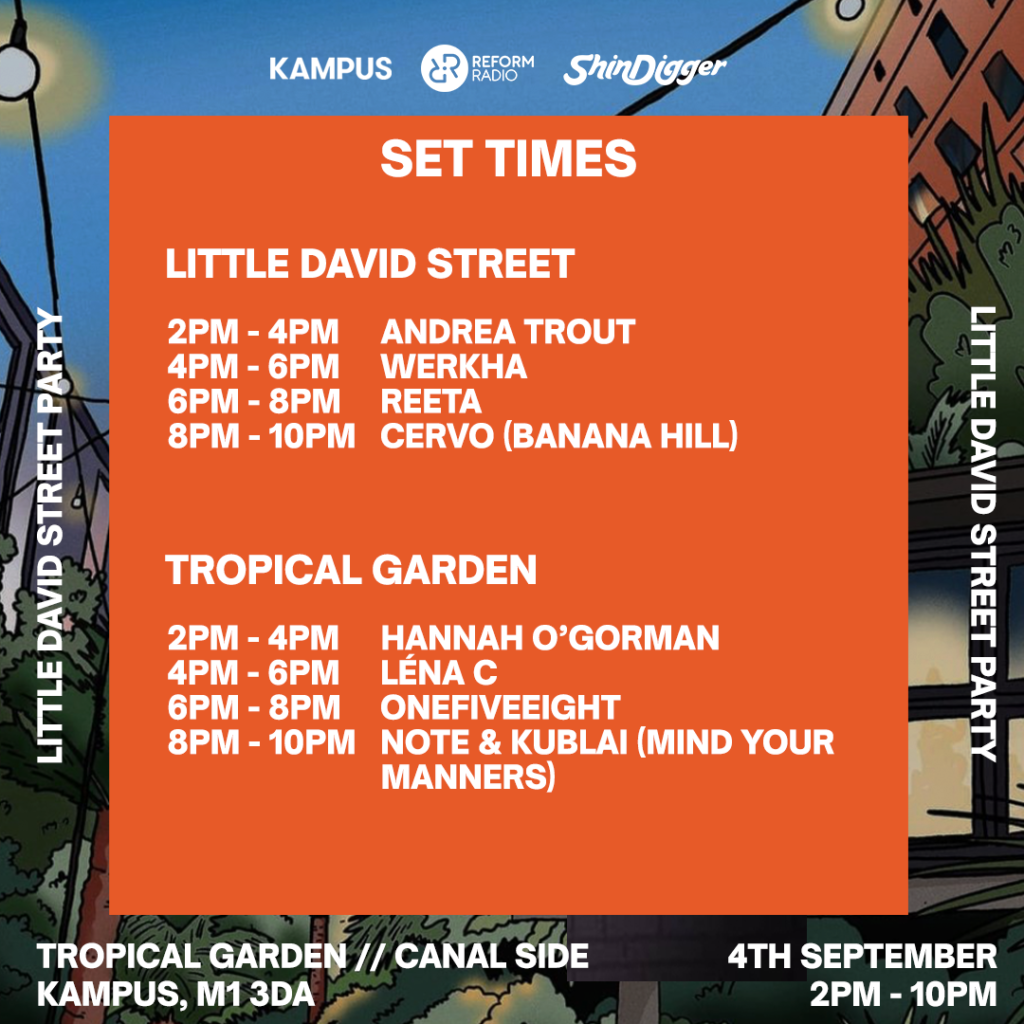
Reform Radio have collaborated with Manchester independent beer company ShinDigger and venue Kampus to host Little David Street Party on Saturday 4th September.
There will be two stages of curated DJ talent for this canal side day party in the Kampus tropical garden, alongside the ShinDigger Beer & Le Social Wine bar with some delicious food pop-ups.
Join us on Saturday 4th September from 2PM-10 PM at Kampus.
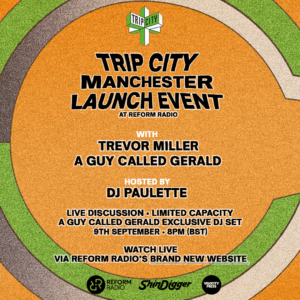
On Thursday 9th September, Reformare set to host an exclusive Northern launch of the cult acid house novel Trip City and soundtrack reissue by Velocity Press withauthor Trevor Miller and pioneering producer & DJ, A Guy Called Gerald.
Hosted by legendary Hacienda resident & broadcaster DJ Paulette, audiences can watch the in-depth discussion exclusively on the revamped reformradio.co.uk launching the same day. The event will conclude with the first DJ set performed by A Guy Called Gerald on his home turf in over two years.
The event, delivered in partnership with Manchester independent beer company ShinDigger, will also be open to attendance at Reform’s studios for 10 randomly-selected audience memebers.
To enter the competition head to Reform Radio’s Instagram and share, like and comment on the Trip City post, tagging the person who you’d like to share the experience with.
The Raise the Bar video series showcases artists delivering freestyles aired on Reform’s shows.
Next to showcase on the series is AYO1, a guest once again invited by the The Daisy Adam’s show.
The Daisy Adam’s show delivers regular live interviews with artist and upcoming MC’s, and showcases fresh freestyles in their Straight Rhymes freestyle segment.
AY01’s freestyle will be premiering on 26th August on Reform’s Youtube at 7PM (BST).
You can also listen back to the full show at Reform Radio’s Mixcloud where all shows are uploaded.
Reform Residents Flute Salad invited the up and coming Manchester band Foxglove to perform on their show.
Alongside the audio recording of the live session, which will be aired on the 23rd July on Flute Salad’s show Point of Flute from 9PM – 11PM, a film recording of the performance will also be premiering on Reform Radio’s YouTube channel on the 29th July at 7PM (BST).
Flute Salad’s show Point of Flute, takes a monthly dive into the trios handpicked tracks from a selection of EPs, albums and independent labels. The show frequently invites their favourite musicians, DJ’s and creatives for discussions and live sessions. Expect eclectic rhythms new and old from jazz, hip-hop, psychedelia, ambient as well as house and disco 12″s.
In their special live session for Point of Flute, Foxglove performed some of their latest material and showcased the bands euphoric indie pop sounds.
Head to Reform’s YouTube Channel at 7PM (BST) on the 29th July to catch the video premiere.
Reform Radio are proud to be prioritising sustainability and the environment, working towards being a carbon neutral radio broadcaster.
Reform believes that they have a responsibility to care for and protect the environment in which they operate in. The radio station is fully committed to improving environmental performance across all of their business activities, and will encourage business partners and members of the wider community to join them in this effort in recognising the key impacts to be in the areas of; energy use, raw material use, waste generation, emissions to air/water, water use, transport, procurement and refreshments.
Reform will strive to:
Adopt the highest environmental standards in all areas of operation, meeting and exceeding all relevant legislative requirements.
Assess our organisational activities and identify areas where we can minimise impacts.
Minimise waste through careful and efficient use of all materials and energy.
Purchase sustainable products wherever feasible [e.g. recycled, FSC or low environmental impact products and energy from renewable sources].
Publicise our environmental position.
Train employees in good environmental practice and encourage employee involvement in environmental action.
Reduce risks from environmental, health or safety hazards for employees and others in the vicinity of our operations.
Adopt an environmentally sound transport strategy
Aim to include environmental and ethical considerations in investment decisions where appropriate.
Assist in developing solutions to environmental problems. Continually assess the environmental impact of all our operations.
Reform’s action plan so far is as follows:
We will be working with Daniel Jackson who is on our Advisory Board to ensure to implement all of our sustainability initiatives and review for news one. Daniel Jackson is the Ethical Awards winner 2015 and will be advising us on new and existing policies.
Reform Radio has developed a series of action plans to supplement each of our environmental policy objectives. These can be found on www.reformradio.co.uk
Reform Radio will periodically review performance.
Reform Radio will now commit to Mondays being remote work only, extending past Covid – 19, to reduce our staff travel emissions by 20%.
Reform Radio have committed to the Cycle To Work Scheme, supporting all staff who wish to access the scheme to more effectively cycle to work. Safe storage and showering facilities have been ensured to be accessible for all staff moving forward.
Northern based artists Sutty and Migxhi’s collaboration single Daisy Chain will be released on the 28th July.
The single is the second release to come out of Rhythm Lab Record’s series giRLs. The series aims to facilitate release-ready collaborations between women who have never met before by providing space, resources and time.
Daisy Chain‘s lyrical message on strained and forced relationships is guided by a soothing and soft swooping electronic RnB track.
Sutty reflects hearing Migixhi’s beat for the first time. “That lovely descending melody you put in that sounds like a music box, Migixhi, I knew I had to write to that. It made me think of when we were playing as kids we’d make daisy chains for fun and they’d be so pretty, but also so flimsy. That sound really reminded me of that.”
Behind the track’s messaging is Sutty’s experience of constantly needing to prove herself and how it has affected her relationship to her music. “That attitude in the industry can definitely give us drive. You want to prove them wrong and show them that music is a viable career. It’s affected me in the way that I really push myself in music everyday, because otherwise there’s this perception that you only do this as a hobby.”
Migixhi, the multi-instrumentalist and producer behind the track adds, “It has affected me, I want to prove them wrong and have them watch me climb up but I try not to give them too much space in my head either because it can be detrimental to my creativity and even my mental health. It can take a toll on you big time if you’re not careful.”
Head to all major platforms on 28th July to listen to Daisy Chain by Sutty and Migxhi.
Hosted by Aisha Williams, the show will be diving into the music of MIF21 and feature interviews with Head of Music Jane Beese & producer of Salaam festival Rizwan Iqbal.
Reform Radio stands in solidarity with the Black community against all forms of racism, discrimination and White supremacy. Reform recognises that it is simply not enough to be non-racist and that we have to be actively and unapologetically anti-racist.
We value, respect and celebrate the huge contribution and influence the Black community has on our world. It is clear that all of us must do better and be willing to reflect on the part we can each play in supporting real progress.
Reform holds a monthly BLM discussion in which we focus on a different piece of media or writing that tackles this topic. The discussion aims to create a space to learn, reflect and discuss the future actions that we can make as individuals and as an organisation.
If you have any suggestions or would like to join, DM Reform or email alice@reformradio.co.uk.
All pieces discussed in the monthly meeting can be found in our resource list (link in bio) alongside many other assets suggested by the Reform team. Once again, if there are any resources that you would recommend to add to the list please get in touch.
Reform’s BLM Resource list includes all the pieces that have been discussed, plus resources that have been found by Reform’s staff members outside of the sessions.
Tough Talks was Podcasting With Purpose‘s first first full production. On the 10th of July, Tough Talks won Best Sex & Relationships Podcast at the British Podcast Awards.
Tough Talks was produced by Reform for Hits Radio & Hits Radio Pride. The series was supported by the Audio Content Fund.
In the series, people from the LGBTQ+ community relive and reflect on a tough talk from their past, covering topics such as gender, sexuality, and identity.
The Podcasting With Purpose scheme has accommodated many podcast productions.
Podcasting With Purposeprovides you with end-to-end production and coaching services from trained, BBC standard producers, as well as editing, upload and podcast promotion, and the chance to record in Reform’s Studio.
The Raise the Bar video series showcases artists delivering freestyles aired on Reform Radio’s shows.
Bringing the rhymes for the second episode of Raise the Bar is Britizen Kane. The artist headed into Reform’s studio to deliver a freestyle for Jorgy & Cheech’s Show.
Britizen Kane’s freestyle will be premiering on 2nd July on Reform’s Youtube at 8PM (BST).
You can also listen back to the full show at Reform Radio’s Mixcloud where all shows are uploaded.
The Raise the Bar video series showcases artists delivering freestyles aired on Reform’s shows.
Invited to guest on The Daisy Adam’s show, Rudeteeth is the first to deliver a freestyle for the Raise the Bar series.
The Daisy Adam’s show delivers regular live interviews with artist and upcoming MC’s, and showcases fresh freestyles in their Straight Rhymes freestyle segment.
Rudeteeth’s freestyle will be premiering on 2nd July on Reform’s Youtube at 8PM (BST).
You can also listen back to the full show at Reform Radio’s Mixcloud where all shows are uploaded.
Black Joy and Climate Activism are two films created through Manchester International Festival and Contact’s Looking Forward to Tomorrow programme.
The two films will be premiering on Reform Radio’s Youtube channel on the 5th and 19th July at 9PM (BST).
Looking Forward to Tomorrow brought together Greater Manchester residents aged 16 to 70 to discuss their hopes, ideas and thoughts on the future. The films showcase an extension of these discussions through the invitation of artists, activists, key workers and campaigners to join their conversation.
In Blakc Joy, host Yandass Ndlovu and artists Tee O Brown, Dorcas Seybuyange and Xana, explore what black joy means to them, positive black representation and taking up space.
Black Joy will be premiering on Reform’s Youtube channel on 9th July at 9PM (BST).
Climate Activism is the second film to be showcased on Reform’s Youtube channel. Emma Greenwood, Youth MP at Bury Council, and young climate activists Debby and Dominion Adegbile (Nigeria), Genesis Whitlock (Antigua/USA) and Mitzi Jonelle Tan (Philippines) discuss climate activism and the North’s role in climate change.
Climate Activism will be premiering on Reform’s Youtube channel on 19th July at 9PM (BST).
In celebration of Pride Month, we have been releasing some special pieces of content from our community and collaborators. Amplifying these voices and the stories of those close to us is at the core of what Reform Radio is all about. For LGBTQIA+ History Month, our staff member Evie shared her story on her journey to becoming her true self as a genderfluid transfeminine woman. Inspired by Evie sharing her story, Reform’s Mental Health and Well-being Manager Dan has written a piece that shines a light on the darker side that Pride can conjure up.
Introducing Dan…
My name is Dan Owens-Cooper. I am a qualified psychological therapist and take pride in my role as Reform Radio’s Mental Health and Well-being manager. I am also a gay man, though (as will be explained) feelings of pride do not always easily accompany this fact.
This Pride month I invite you to read my experience of the darker side of LGBTQ+ pride, an aspect sometimes assumed to be confined to the past, a silent pain still felt by so many but so rarely acknowledged.
We need to talk about shame.
Once consigned to little more than 1 of 7 seven deadly sins, the term ‘pride’ in 2021 is synonymous with celebrations of the emancipated (or emancipating) LGBTQ+ community. Conjuring up images of rainbow flags, parades, social action and (for some of us) hazy recollections of dancing to B*witched ‘C’est La Vie’ in Piccadilly’s underground car park…but the less said about that the better.
Questioning the community’s attachment to the term Pride is understandable, and whilst Google may have its own answer, let me tell you what pride means to me.
Pride means the absence of shame but exists only in its relationship to shame. The two are co-dependent, much like day and night, hot and cold, Ant and Dec – one cannot exist without the other. They are, like it or not, opposing sides of the same coin. With being gay so publicly aligned with Pride in 2021, you may be forgiven for assuming that shame and the LGBTQ+ community have shared little more than a passing glance at each other. But for me and many others in the community, such a position of blissful ignorance is something we could have only dreamed of. Because for many in the LGBTQ+ community, shame has been inescapable. It’s been intoxicating. Doing to our self-concept what sour milk does to a fresh hot beverage. And as anyone who has taken that first enticing sip of such a concoction will know – it kind of leaves a bad taste in one’s mouth.
This is gay shame. A pervasive feeling of (at best) inadequacy and (at worst) worthlessness.
As a child and teenager exposed to an onslaught of anti-gay messages, I was helpless to prevent shame from being woven into the fabric of my identity, and colouring my sense of worth in all aspects of my being (not just sexuality).
Unstitching that, has been a decades long endeavour, and one that will continue my whole life. My appearing at ease with my sexuality, perhaps confident even, belies the truth that is this – Pride is something I continually aspire to. Shame is an unwelcome reality.
I was 15 years old when I came out. I’m proud of that. There’s a fine line between bravery and stupidity and coming out to anyone whilst in my final year at a Bolton Catholic High School could, in hindsight, be considered the latter. Because, for context – being gay then and there was unthinkable. Literally. Gay was nothing beyond a slur. Packing, in just 3 letters, a knockout punch that most 4-letter curse words could only dream of. To self-identify as it would be as incredulous as self-identifying as excrement. No-one would do it. No-one in their right mind at least. And no-one did.
There was barely a context I experienced then in which LGBTQ+ identities were discussed in anything but derogatory terms. Section 28 (an actual law, making it a criminal act to promote, in British schools, same-sex relationships as a moral equivalent to heterosexual relationships) made damn sure that this hostility extended even into my classroom. This meant that as a schoolboy who would become a gay man, I was denied any education on safe same-sex practices. Talk about unprotected. I mean, just imagine if there had been a sexually transmitted killer virus spreading like wildfire through the community. Raises eyebrow.
No discussion of HIV and AIDS. No discussion of gay sex, gay deaths, gay life, gay people (if we were classed as people), gay love, gay relationships, gay … anything. Unless of course gay hate was your thing. This was not only legal, but virtually prescribed by acts like Section 28, and seemingly all the rage.
Thinking back to those months and years after coming out, my stomach flips. To come out at that time meant embracing shame. It meant accepting you were unacceptable to society, and just sticking 2 fingers up at them, revelling in the disgrace of it all and just doing being gay anyway. As a seasoned people pleaser, this position of rebellion was not one I would have willingly chosen. In an offering that was about as desirable as ‘Sophie’s Choice’, I found myself forced to choose between living a shameful life or living a shameful lie – and so it was the former on which I settled. It was every bit as exciting as it was mortifying and a shame infused thrill was my default emotional state, with self-loathing and excitement tussling constantly for poll position. For a while at least. It was a lot … for a 15 year old.
Believe it or not – I know what it’s like to loathe the LGBTQ+ community. I know because I was there in the 80s and 90s, subject to the same anti-gay messages that conditioned so many others at the time and decades before.
Being gay does not prevent society’s prescribed moral code seeping into your conscience. And being gay does not make that associated shame budge easily. Even when you realise that you are the thing you were raised to hate.
You see, I learnt like everyone else that gay was disgusting. Only for me, learning that gay was disgusting meant learning that I was disgusting. Adults, teachers, newspapers, politicians all taught me that I was disgusting. It was a lesson that would see me, aged as young as 11, fearing the sickening possibility that I might be attracted to men. Lay in my childhood bed weighing up my severely limited options, which included (as far as I could see) maintaining a sham marriage just long enough to conceive children. Having heard my mum talk about how one day I would pass my toys and books onto my children, it broke my heart to think I might disappoint her. Not that I expect any child of the future would be interested in a 1989 Neighbours annual anyway, but I suppose you never know.
Other ‘options’ included disappearing to a remote country, cutting off friends and family, or – if push came to shove – ending my life. If you’re worried about the distress I felt, contemplating this as an 11 year old, then you shouldn’t. Because it wasn’t distressing. In fact, the idea that I had a ‘get out’ if things ever got so bad was a comfort, not a fear. Which tells you something about the value I placed on my life then. “I had those exact thoughts and fantasies” said my gay friend James when we became friends almost 10 years later. It seems he too had endured this shameful strategizing as a child. Knowing this might have brought comfort to me, had it not come 10 years too late. That 11 year old could have done with knowing he wasn’t alone after all.
In my later teens, then openly gay to increasing numbers, I took a regrettable path that was and still is well trodden by those within the community. A path leading to a position I like to call “I’m not one of those gays”. I wasn’t one of those gays that always went to gay bars. I wasn’t one of those gays that was ‘camp’ (thankfully the time I paraded downstairs dressed in my mum’s wedding dress was pre-social media – no body, no crime). I wasn’t one of those gays that was ‘just about being gay’. Because – heaven forbid, right?!
This was me clinging to scraps of mainstream societal acceptance that may have still been available. I recall my position being endorsed by an older heterosexual acquaintance, telling me how he’d “seen them all down at Soho” and that I wouldn’t want to be doing all that. Of course, it didn’t matter that this nameless acquaintance had a track record of extra marital, uninvited groping of females – it went without saying: gays were worse.
I didn’t recognise the harm I was doing to myself, playing a willing and active role in the process of gay shaming. One foot in the community, the other aligning with the homophobic party line that had plagued me my whole life. I know better these days and I feel very sensitive to ongoing divisions centred around homophobia within the LGBTQ+ community, and listen out for them in myself. Profiles and conversations on Grindr are too often littered with terms like “str8 acting”, “no camp”, “no fems”, “non-scene”, and the practice of “slut shaming” is common. The fact I’ve yet to see a profile that says “no str8 acting” is indicative of the unspoken consensus (be it conscious or otherwise) that “str8” ways of being, carry greater cultural currency even in the gay world. If in any doubt about the pervasiveness of this bias, ask yourself how you would feel if you heard someone say to a gay person “you don’t seem gay!”, compared to how you’d feel if they said “you don’t seem straight!”. Incidentally, I’ve been on the receiving end of both, and hate the fact that part of me feels flattered on hearing the those words: “you don’t seem gay”. It’s a feeling that was put there by society. It’s indicative of shame and I don’t want it.
It’s 20 years since I first said the words “I’m gay” to another person. I wish it didn’t, but writing those words still evokes an inkling of shame.
Partly (no doubt) because I recall the overwhelming tidal wave of shame that first conversation brought crashing down on me, but also because my personal process of ‘gay shame detox’ is far from complete. I’m proud to say that the shame that once sounded like a deafening heavy metal concert (with me in the mosh pit), is now more like a faint unwelcome whisper. It’s an echo from the past, quiet enough to not provoke a reaction, but loud enough to be heard and cruel enough to still sting.
It saw me get to the age of 34 before I felt able to be open about my sexuality in all my employed roles, by which point I had been married 3 years (… to a man). 34 years walking this endless walk of shame, dodging particular questions, squirming at being asked in front of a captive audience of colleagues whether or not I would want my wife to take my surname, swerving conversations that might invite any personal disclosure. You can only imagine the barrier this presented to forming any kind of meaningful social connection to colleagues. It’s no wonder that, even after 10 years service, “he keeps himself to himself” was a phrase so often attributed to me in my last role before Reform Radio.
This veil of silence extended to some personal relationships too. Having felt paralysed by such overwhelming shame after coming out to my mum at 16, neither of us mentioned it again for almost a decade. A big rancid elephant by the name of shame in the room that was our, otherwise close, relationship. Shame stopped her from really knowing me for so long. Speaking more openly has come later than I would have liked, but better late than never.
Incredible advancements by the LGBTQ+ movement in the UK may have accompanied my healing process but it did not deliver it. It’s true I’m healing, but there is no protective legislation in the world that could give me my childhood back. No amount of attended Pride weekends can bleach the shame of weeks, months, years on end being battered with anti-gay messages from the mouths of everyone from my Prime Minister to my Lollipop Lady, both (incidentally) tasked (in their own particular ways) with the job of serving and protecting me. Both (incidentally) failing.
As a therapist I often say that the process of healing from shame is a difficult one to articulate, but I will try. It’s not a pretty picture, since it invariably involves one becoming (for a period at least) fully submerged in the sea of shame one has been treading water in for so long.
Healing from shame for me involves an ongoing process of relationship building with my inner child (that part of me still wounded, housing the shame, blaming himself). I try to provide to him now the acceptance society denied him then. He informs my tastes still too, as any casual glance at some of my Spotify playlists would confirm* (*those averse to 90s female singer songwriters and/or Victoria Beckham’s solo material might want to steer clear).
I have moved towards relationships in which I feel wholly accepted and asserted boundaries that safeguard me against anything less. I am open about my sexuality most of the time, because ‘outing’ our shame is the ultimate weapon in the fight against it. I resist wherever possible the urge to hide my sexuality, even when being truthful creates awkwardness and discomfort. If those inner workings of my psyche are to ever fully accept that being gay is not shameful, then I must behave consistently with that position. I try to build good relationships with gay people, and discourage within-minority prejudice. I try to live authentically to avoid colluding with shame, and to embody in as far as possible my belief that ‘it’s okay to be who you are’ (even if that means admitting to an unhealthy familiarity with the script of Spice World: The Movie … you know, if that were your thing).
I’m not perfect, but I like myself. I didn’t deserve the onslaught of gay denigration that characterised my childhood, but it was a toxicity that touched all of us who lived through it, gay, straight or otherwise. Lessons are hard to unlearn. Inherited beliefs are tough to shake. Despite the amazing progress made by the LGBTQ+ community and the pride we profess, generations who have digested anti-gay messages see the lingering shame that still divide family relationships, still breed inner turmoil, and still give rise to immeasurable barriers to long overdue acceptance. Acceptance that should never have been denied in the first place.
Thank you to everyone who has taken the time to read about my experience.
I do not pretend that it is representative of every LGBTQ+ individual who experienced a less inclusive time, but I hope it may encourage discussions that bring into focus those ripples of shame still felt today.
So as to out gay shame from the fabric of our lived experience, stich by stich, and to shine a light on the silent internal battles ongoing in an era when one could be forgiven for thinking the battle was all but won for the LGBTQ+ community.
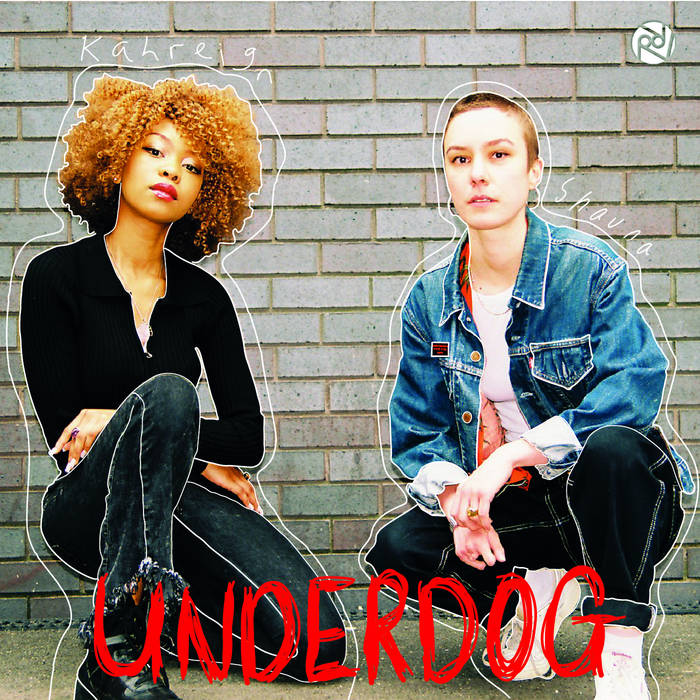
Manchester based artists Kahreign and Shauna‘s collaboration single Underdog will be released on 30th June.
The single is a debut release to come out of Rhythm Lab Record’s series giRLs, a series that aims to facilitate release-ready collaborations between women who have never met before by providing space, resources and time.
Kahreign has spoken on the motive behind the tracks saying how “Underdogs are the people you don’t see coming and I see that in myself and I definitely see that in Shauna too, the path for us in the music industry is tumultuous but it’s going to be even more rewarding when that path leads us straight to the top.”
Shauna adds to this stating, “I think women in the music industry are Underdogs, they don’t get enough recognition or as much love as their male counterparts. I think all minorities in the music industry are Underdogs.”
Head to all major platforms on 30th June to listen to Underdog by Shauna and Kahreign.